Request Consultation
You are reading this page probably for one of the following reasons:
Your enrollment is stagnant or declining. You want to change the trend. How does SP/SFM do that? By providing:
- A thoughtful comprehensive approach to your data
- Structures and practical steps for enrollment growth
- A long-term financial projection to meet the needs of today and tomorrow
- A Biblical lens
- Answers to these:
- “We’re not the same school we were 10 years ago.”
- “Our mission is on the wall but not in the classroom.”
- “We’re losing our distinctiveness.”
- “We don’t know our value proposition.”
- “We’re losing families to the public schools / other Christian schools.”
You are under financial stress: you and your community don’t want every meeting to be financial crisis management. How does SP/SFM reduce and then eliminate financial crisis? By providing:
- Deep category analysis of your current budget
- Biblical wisdom with financial planning
- Financial supports and structures to support deep planning
- Key Performance Indicators to indicate progress
- Systems approach so that solutions are not just band aids
- Answers to these:
- “We can’t keep doing this.”
- “We’re one bad year away from crisis.”
- “We don’t have a long‑term financial model.”
- “Tuition increases are not sustainable.”
- “Our deferred maintenance is increasing.”
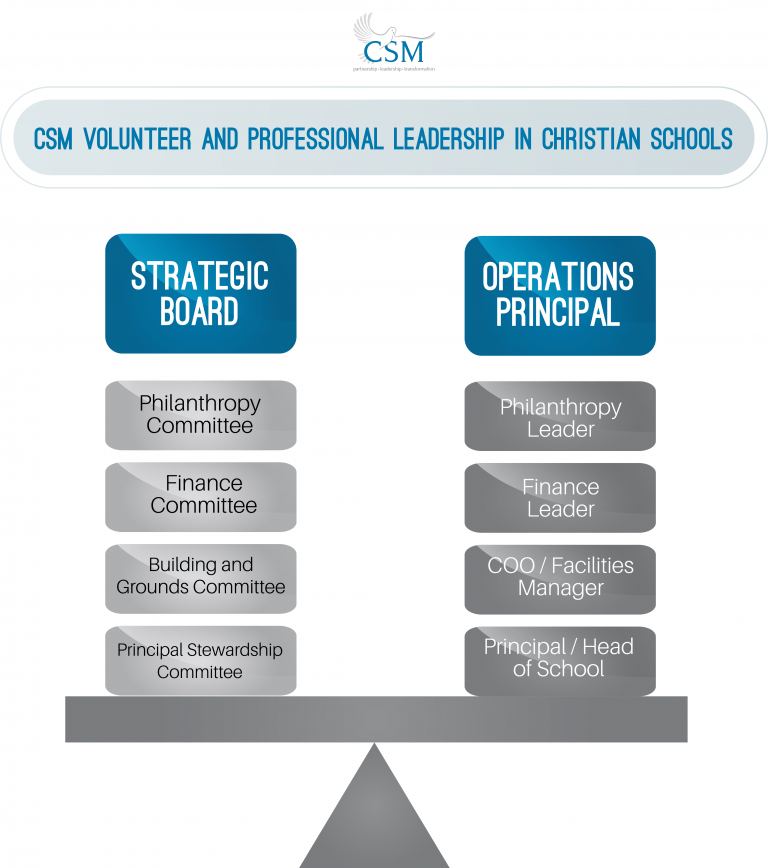
Your Board is not operating well: the Principal and Board of Trustees / Directors are not on the same page. How does the Strategic Plan and Strategic Financial Management align strategic governance and tactical operations and ensure everyone is operating in their own lanes while connecting as a unified operation? By providing:
- A clear path with laid out responsibilities
- Defined roles for the Board and for Board Committees
- Support and accountability for the Principal
- Discipline around what is strategic and what is tactical/operations
- A unified vision
- Answers to these:
- “We need to get out of the weeds.”
- “We don’t have a shared vision.”
- “We need a governance reset.”
Other pain point reasons might include mission drift or confusion, leadership transition and/or fatigue, the lack of academic vision aligned with mission, facility limitations and need for capital campaigns, annual giving limitations, competition and shifting demographics.
There are also very positive reasons for strategic planning and strategic financial management: a sense that God is calling us to more; a desire to do it the “right way”; striving to improve the child’s education in the classroom; understanding that a 3rd party will provide an unfiltered view of the school to drive excellence; expanding the vision of your school through the lens of hundreds of Christian schools; understanding and learning how to apply Scripture, research, and experience.
Whatever your reasons for pursuing Strategic Planning and Strategic Financial Management, the result is the same: a focused, knowledgeable Board and leadership team equipped with hope, confidence, and clarity. They can see a future in which classrooms are full, finances are healthy, and the school’s vision for transformation is vibrant. The result is also a school community that trusts deeply, partners willingly, and prays faithfully for mission success.